
Aldehyde C-10
Decanal
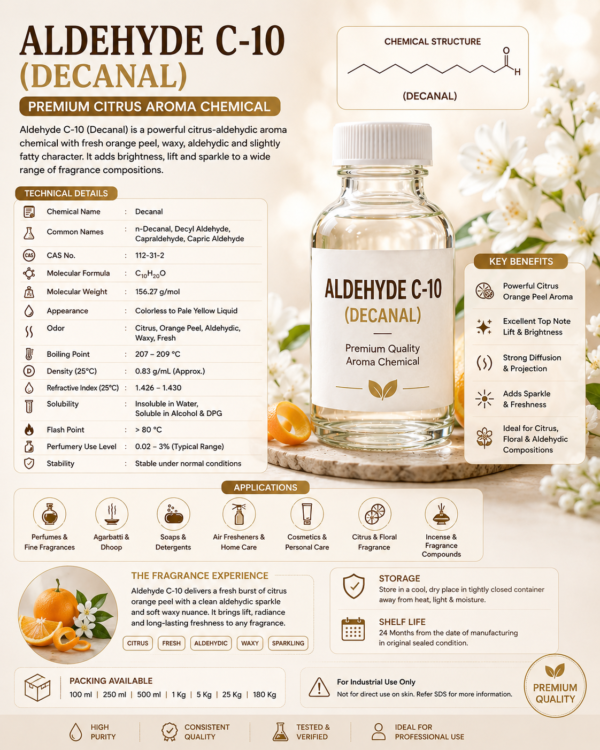
Aldehyde C-10, also known as Decanal, n-Decanal or Decyl Aldehyde, is a powerful fragrance aroma chemical belonging to the fatty aldehyde family. It is valued in modern perfumery for its characteristic fresh citrus, orange-peel, waxy, aldehydic and slightly fatty character.
Aldehyde C-10 is particularly useful when a fragrance needs brightness, lift, sparkle, freshness and diffusion. It can be used as an accent material in citrus, floral, aldehydic, fresh, clean, soap and functional-fragrance compositions.
The material is highly potent, so it is normally incorporated into fragrance compositions at relatively low levels. Kao lists a typical perfumery dosage range of approximately 0.02–3%, depending on the formulation and desired effect.
Key Features
- Powerful citrus-aldehydic aroma
- Fresh orange-peel and citrus-rind character
- Waxy and slightly fatty undertone
- Excellent top-note lift
- Adds sparkle and brightness
- Strong diffusion
- Useful as a floral modifier
- Suitable for citrus and aldehydic accords
- Useful in fresh, clean and soapy fragrance compositions
- Compatible with a wide range of perfume materials
Odor Profile
Primary: Aldehydic, Citrus, Orange Peel
Secondary: Waxy, Fresh, Fatty, Floral, Clean
Olfactive character:
Freshly peeled orange and citrus rind with a powerful aldehydic sparkle, supported by a soft waxy/fatty nuance.
Because of its high odor strength, smelling the material in a low dilution is recommended when evaluating it.
Perfumery Applications
Aldehyde C-10 can be used as a powerful modifier and top-note accent in:
- Fine fragrances
- Eau de parfum and perfume compounds
- Citrus fragrances
- Orange accords
- Bergamot and lemon accords
- Aldehydic perfumes
- Floral bouquets
- Rose accords
- Jasmine compositions
- White-floral fragrances
- Soap fragrances
- Fresh and clean fragrances
- Musk compositions
- Functional fragrances
- Agarbatti and Dhoop fragrance compound
- Home-fragrance formulations
- Air-freshener compounds
- Detergent and cleaning-fragrance compositions
What Aldehyde C-10 Does in a Formula
Used correctly, Aldehyde C-10 can:
Lift – gives the top note more elevation and radiance.
Brighten – makes citrus and floral accords feel fresher.
Diffuse – increases the initial projection of a composition.
Add Sparkle – introduces a distinctive aldehydic brilliance.
Modify Florals – can sharpen and brighten floral bouquets.
Add Citrus Character – creates an orange-peel/citrus-rind effect.
Recommended Perfumery Use
Aldehyde C-10 is a high-impact material and should generally be evaluated at low concentration.
For formulation trials, start with a diluted solution and increase gradually according to the desired effect. Kao reports a typical perfumery dosage range of 0.02–3%.
For professional fragrance development, the appropriate level should always be determined by the complete formula, application, substrate and applicable safety requirements.
Technical Details
| Parameter | Specification / Information |
|---|---|
| Product Name | Aldehyde C-10 |
| Chemical Name | Decanal |
| Common Name | Decyl Aldehyde |
| Synonyms | n-Decanal, Capraldehyde, Capric Aldehyde |
| CAS Number | 112-31-2 |
| Molecular Formula | C10H20O |
| Molecular Weight | 156.27 g/mol |
| Chemical Class | Fatty Aldehyde / Aroma Chemical |
| Appearance | Colourless to pale-yellow liquid |
| Odour | Strong citrus, aldehydic, waxy, orange-peel |
| Olfactive Family | Aldehydic / Citrus |
| Boiling Point | Approximately 207–209°C |
| Density | Approximately 0.83 g/mL |
| Refractive Index | Approximately 1.426–1.430 |
| Water Solubility | Practically insoluble |
| Alcohol Solubility | Soluble |
| DPG Compatibility | Soluble |
| Perfumery Position | Mainly top-note / modifier |
| Typical Perfumery Use | Approx. 0.02–3%, depending on formula |
Technical reference data for decanal include molecular weight 156.27, boiling point around 209°C, refractive index 1.426–1.430 and specific gravity around 0.823–0.832.
Compatibility
Aldehyde C-10 works particularly well with:
- Bergamot
- Lemon
- Orange
- Mandarin
- Grapefruit
- Petitgrain
- Neroli
- Rose
- Jasmine
- Gardenia
- Muguet materials
- Phenethyl alcohol
- Floral aldehydes
- Musk materials
- Woody materials
- Fresh aromatic materials
It can be especially effective where a formula requires citrus freshness combined with aldehydic diffusion.
Professional Formulation Tip
Aldehyde C-10 is not intended to make a fragrance smell simply “more citrusy.” Its real value is its ability to provide radiance, aldehydic lift and orange-peel freshness.
At excessive levels it can become sharp, fatty, waxy or harsh. For this reason, professional perfumers normally build the desired effect gradually from a low dilution rather than adding large quantities directly.
Storage
Store in a tightly closed container in a cool, dry location away from excessive heat and direct light. Supplier technical information also recommends protection from air/oxygen where appropriate.
Safety & Compliance
This product is a concentrated aroma chemical for professional formulation use. It should not be applied neat to skin or used as a consumer product by itself.
For cosmetic, fine-fragrance, soap, detergent or other consumer applications, always check the current IFRA requirements, SDS and supplier documentation for the specific material grade and intended end-use category. IFRA limits can depend on the finished-product application and concentration.
For industrial use and fragrance formulation only.
Why Choose Aldehyde C-10?
Aldehyde C-10 is a useful professional aroma chemical when you need:
Freshness + Citrus Lift + Orange Peel + Aldehydic Sparkle + Diffusion
Its combination of powerful odour strength and distinctive citrus-waxy character makes it a valuable material for both classic aldehydic structures and modern fresh fragrance compositions.
Reviews
There are no reviews yet.